Dashed Circle Solid Works Drawing
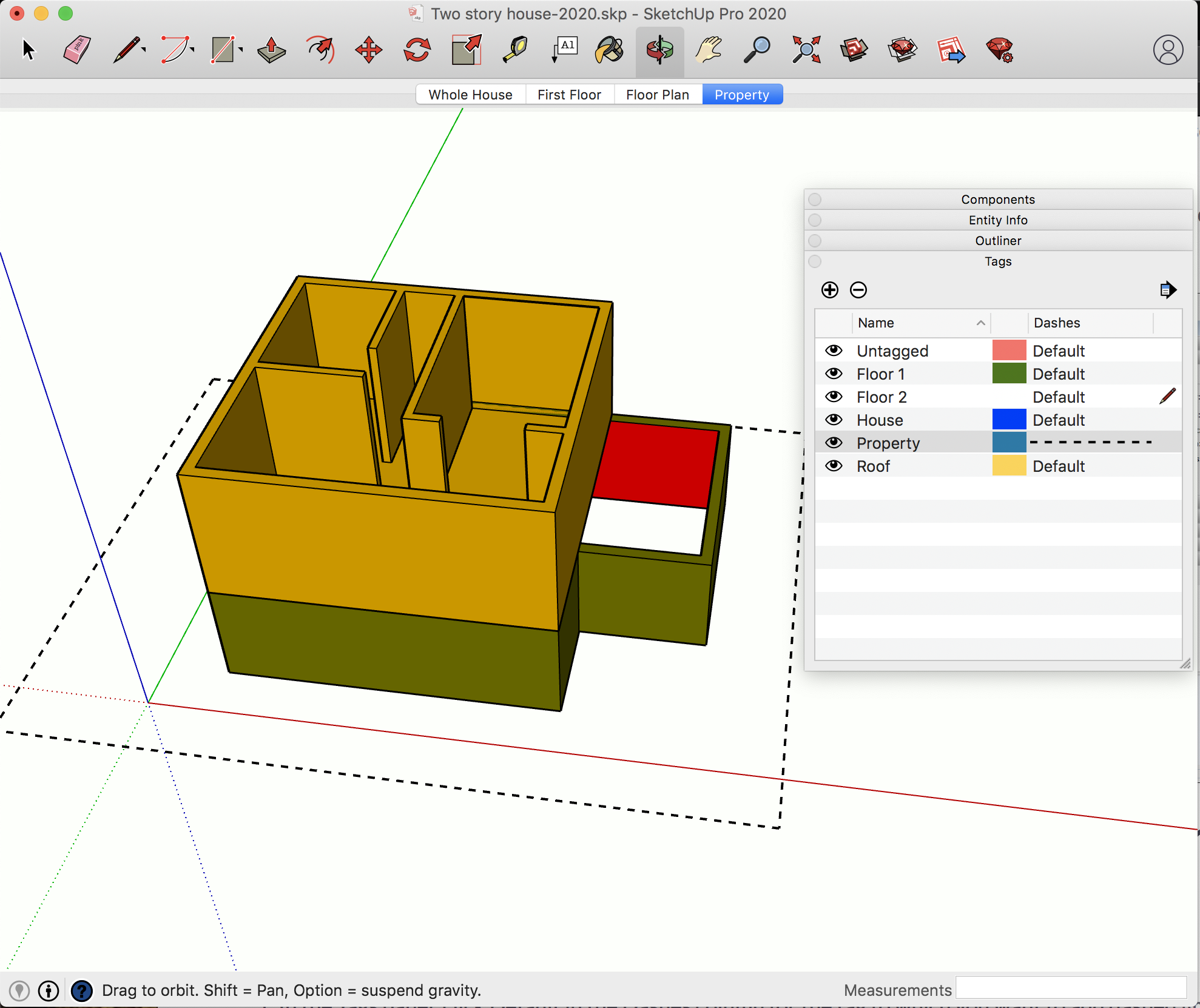
In SketchUp, the Tags Console has dash patterns so you can alter entity lines on a tag from solid to dashed. Whatever geometry on the tag inherits the tag's dash pattern. Dashed lines announced in the model view at whatever screen scale.
With these nuance patterns, you tin can ascertain property boundaries, identify elements to be demolished in a model of an existing structure, or create a filigree or reference lines (for elements like topology or hidden pipes or services).
Dashes also assistance you follow simple and efficient workflows when y'all use SketchUp with LayOut and/or a CAD program.
For details well-nigh how SketchUp tags work, encounter Controlling Visibility with tags.
Table of Contents
- Follow the dashes workflow
- Choose a nuance pattern in the Tags Console
- Control dashes of components and groups
- Toggle nuance pattern visibility
- Piece of work with dashes imported from a CAD file
- Print a model with dashes
- Export an image or model with dashes
Follow the Dashes
Considering you select dash patterns in the Tags Panel, it'southward helpful to recollect virtually how to utilize dashes in the overall context of working with tags:
- When you describe your model, draw on Untagged and create groups or components equally you normally would.
- Use tags to organize entities by type, such as a tag for trees and a tag for buildings or a dissever tag for each floor of a building. (See Controlling Visibility with Tags for more information.)
- When you want to assign a nuance design to a tag, give the tag a name that clarifies what the dash pattern communicates. For case, you might proper noun the tag Property Boundary, Sabotage Lines, or Underfloor Heating.
- In the Dashes cavalcade of the Tags Panel, select the nuance design you'd like to apply to the tag. Choose from several styles with dashes, dots, or some combination.
- Motion the geometry that will have dashed lines to the tag you created. To move geometry to a tag, select the geometry you want to move and utilise the Tag driblet-down menu in the Entity Info panel to motion the selected geometry to the desired tag.
- (Optional) Toggle the visibility by tag to hibernate geometry or suit whether all lines are solid or dashed globally for the model in the Styles panel.
Choose a dash pattern in the Tags console
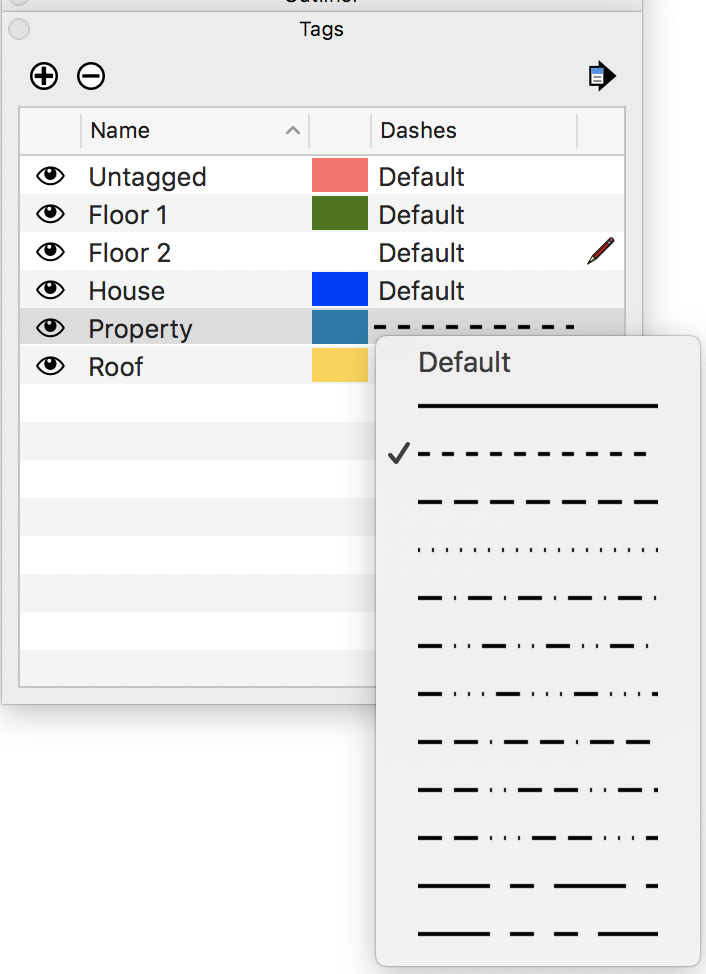
To choose a nuance pattern for a tag, follow these steps:
- In the Tags panel, click Default in the Dashes column for the tag to which you lot want to add dashed lines.
- Select the dashed line manner from the menu that appears. Any geometry on the tag now has dashed lines.
Tip: If you lot don't run across dashed lines, select the geometry that should be dashed and employ the Entity Info console to check that the geometry is on the right tag. If that doesn't piece of work, open the Edit tab of the Styles panel, select the Edge Settings icon, and make sure the Dashes checkbox is selected.
With the Profiles and Depth Cue edge style options, edges announced thicker or thinner to create certain furnishings. These varied thicknesses apply to dashed lines in the same mode they apply to solid lines.
Control dashes of components and groups
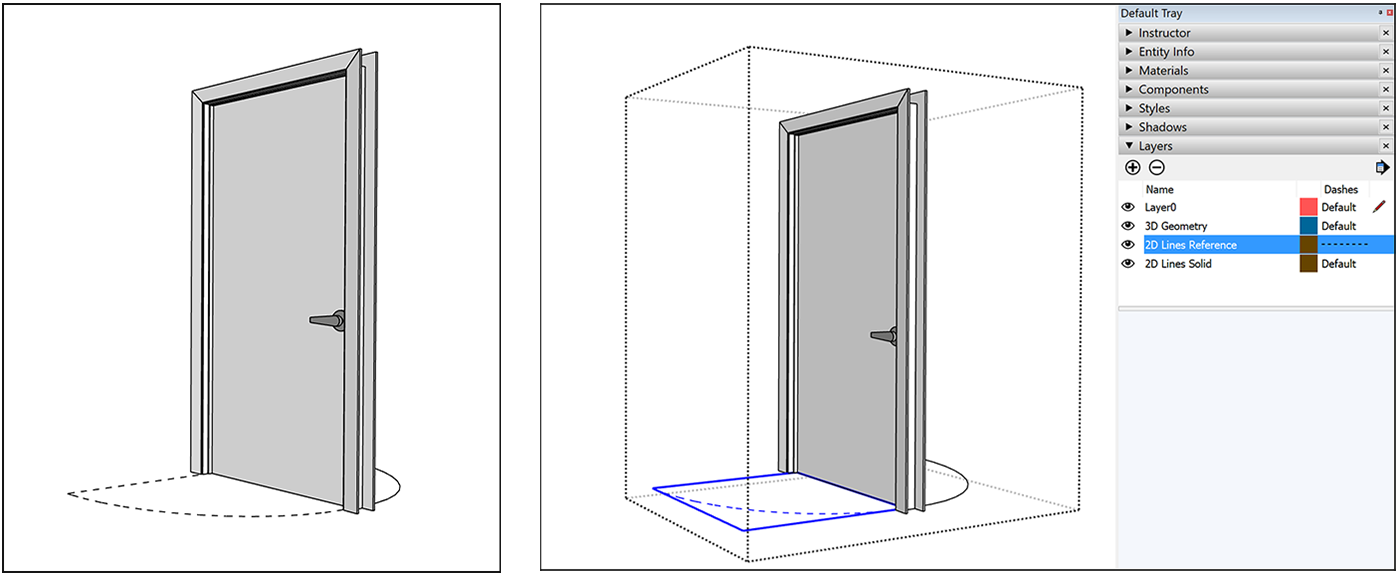
Annotation that components and groups inherit the nuance style of their tag with i exception: edges assigned to a tag with a dashed line way within the component practise not inherit the component'due south line style.
Tip: You might exist familiar with the fashion components inherit dashed lines if you're familiar with the way components inherit materials. Y'all tin apply a material to an entity within a component and and then utilize a different material to component.
With this behavior, a component can comprise 3D geometry and a patterned 2D representation on different tags. The following figure of a door is an example. The dash pattern that illustrates how the door swings is inside the door component, and the lines of the 3D door and 2d swing blueprint are different.
Toggle nuance blueprint visibility
Tags were designed to control the visibility of the geometry on a tag. When yous toggle a tag's visibility, you toggle the visibility of the edges and their dashes on that tag. To toggle a tag'due south visibility, clear the Visible checkbox for the tag in the Tags Panel.
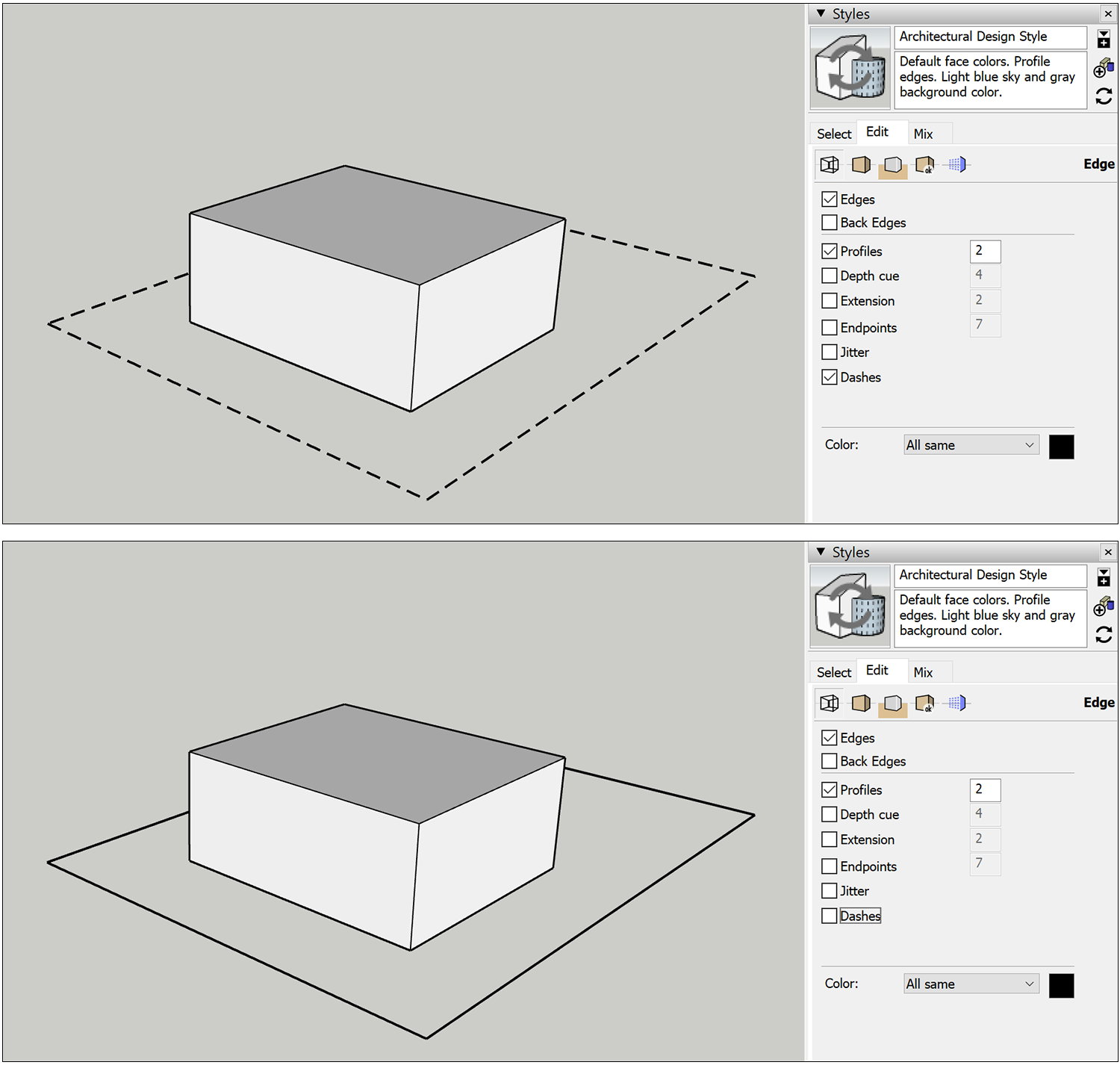
Globally, you tin command the visibility of only the dashes via the Styles panel. To show dashes, brandish the Edge Settings on the Edit tab and select the Dashes checkbox. When you articulate the Dashes checkbox, the lines are visible but the dashes are not.
Piece of work with dashes imported from a CAD file
All CAD line styles (majestic and metric equivalents) can be imported. When yous import a CAD file (.dwg or .dxf) into SketchUp, the tags from the CAD file appear in SketchUp and retain a close approximation to the original dashed lines.
Note: When SketchUp doesn't offer a dash blueprint that'southward an exact lucifer for a CAD line style, SketchUp uses the closest match. If SketchUp doesn't offer a close lucifer for a CAD line fashion, the line appears with a solid dash blueprint.
You can change the dashes in SketchUp on the Tags Console by selecting a dissimilar dash pattern for the tag.

Print a model with dashes
Although you can print a model with dashes directly from SketchUp, using LayOut to print is recommended. For a professional SketchUp user, LayOut enables you to print more accurately and offers more command over size, folio setup, and line thickness and quality.
To print a model with dashes from SketchUp, hither's the recommended workflow:
- Consign the model equally a PDF, which is a 2D vector graphic file.
- Print the PDF using a tertiary-party application for printing PDFs.
On macOS, you can also print the model to a PDF via the impress dialog box with expert results.
If you choose to print a model via LayOut, here are a few tips for working with dashed lines in LayOut:
- You can add your SketchUp model to a LayOut certificate.
- Control the line thickness using the SketchUp Model panel. By default, the dashed lines appear at a 0.5pt scale.
- To suit the stipple length, you can arrange the calibration factor separately from the line weight, which will stretch or contract the repeating design
Export an image or model with dashes
When your SketchUp model contains dashed lines, you tin preserve the dashes when you export to the following formats:
- Vector image formats: PDF and EPS
- Raster image formats: PNG, JPEG, TIF, BMP
- CAD format: DWG and DXF
If the SketchUp model was originally imported from a CAD file and y'all didn't edit the dashes, the dashes should remap back to the original CAD line styles. Otherwise, the SketchUp dash pattern is remapped to the equivalent CAD line way.
Source: https://help.sketchup.com/en/sketchup/applying-dashed-lines-layers
0 Response to "Dashed Circle Solid Works Drawing"
Post a Comment